ChemRecon
v. 0.1.2
ChemRecon is a Python library and consolidated meta-database designed to simplify the integration and exploration of biochemical data from a range of sources. It is built from full-database downloads of compounds, reactions, enzymes, molecular structures, and atom-to-atom maps from the following source databases: BiGG, BRENDA, ChEBI, ECMDB, M-CSA, MetaMDB, and PubChem.
Heterogenous data formats were standardized, and relationships within and between these databases were reconstructed in a consistent format. The resulting meta-database is freely accessible online and is complemented by a Python library which allows for easy integration into existing workflows. This enables unified querying of entries from all the source databases, and discovery and visualization of relationships between these entries.
ChemRecon was developed at the Algorithmic Cheminformatics Group, Department of Mathematics and Computer Science, University of Southern Denmark.
Paper
If ChemRecon proves useful to your research, you may want to cite the following paper.
ChemRecon: a Consolidated Meta-Database Platform for Biochemical Data Integration
C. A. Eriksen, J. L. Andersen, R. Fagerberg, D. Merkle
Arxiv preprint, submitted to Bioinformatics.
Availability and Installation
ChemRecon is available via your Python package manager from the Python Package Index (PyPI): chemrecon It can be installed using pip:
pip install chemrecon
Visualizing entry graphs requires GraphViz to be installed, and for the dot executable,
which renders the graphs, to be available on your system’s PATH.
See the GraphViz Python package for instructions.
Documentation
The documentation, including instructions on usage, tutorials, and complete description covering the types of entries and relations supported, is available on the ChemRecon homepage.
Usage
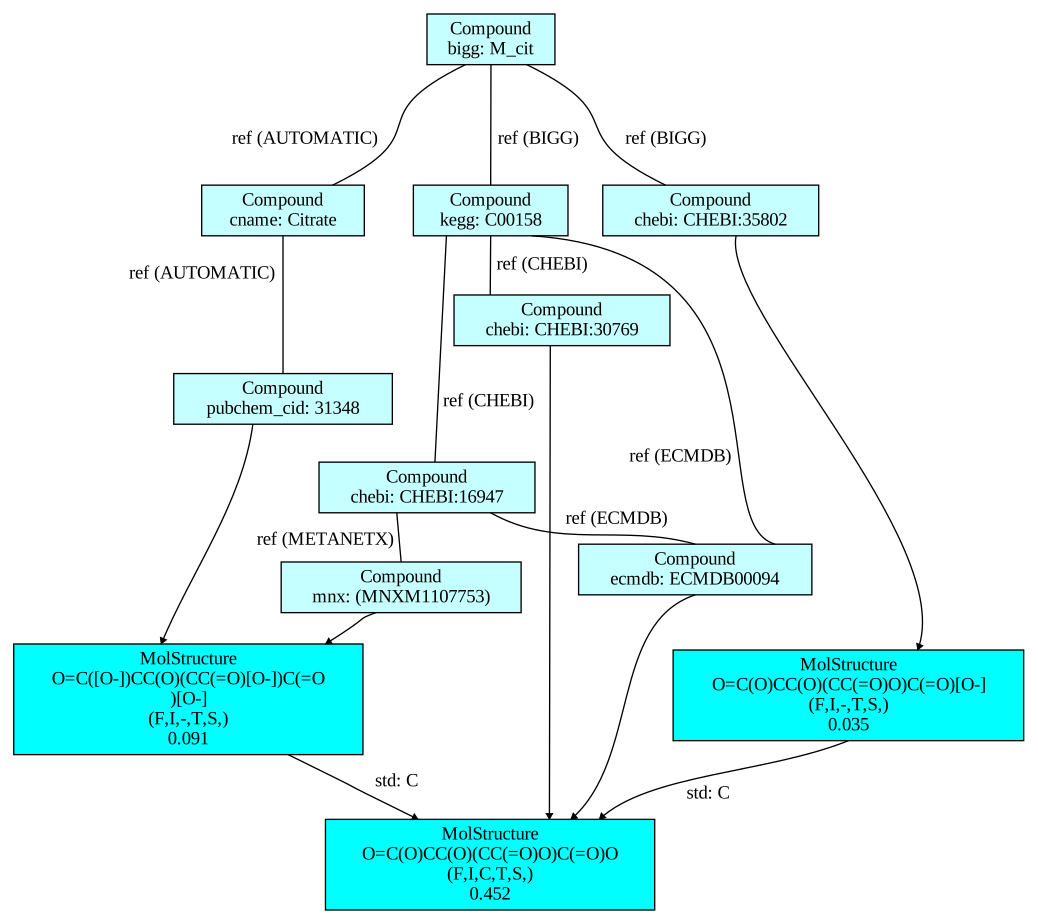
The following is an example of a typical ChemRecon workflow, producing the graph seen above. For more detailed examples, see the tutorial section of the documentation.
from chemrecon import *

connect_public()

# Perform a database query to find the 'citrate' entry in BiGG.
citrate_entry = find_entry(id_type = C_BIGG, source_id = 'M_cit')

# Define a protocol to find related entries and molecular structures (protocols like this are included)
compound_structure_protocol = ExplorationProtocol(
    relation_types = {CompoundReference, CompoundHasMolStructure, MolStructureStandardization}
)

# Create and expand an entry graph, according to this protocol, by traversing the database.
eg = EntryGraph(initial_entries = {citrate_entry})
explore(eg, compound_structure_protocol, steps = 5)

# Score the molecular structures in the graph according to their 'connectedness'
scorer = Scorer(score_entry_type = MolStructure)
scores = scorer(citrate_entry)  # Result is an OrderedDict

# Draw the graph with these scores, producing the image seen on this page
eg.show(scores = scores)
Database
ChemRecon needs to be connected to a database to function. The easiest is to connect to the public database, hosted by SDU:
connect_public()
Alternatively, a local instance of the database can be hosted via Docker. Instructions are given in the documentation. This has the advantage of lower latency, making queries and entry graph construction faster, and allows adding custom data sources.
Source Databases
ChemRecon contains compound, molecular structure, reaction, atom-to-atom map, and enzyme entries from the following databases.
Source |
Compound |
Structure |
Reaction |
AAM |
Enzyme |
Version |
|---|---|---|---|---|---|---|
BiGG |
20428 |
- |
33942 |
- |
5705 |
1.6 |
BRENDA |
- |
- |
61129 |
- |
8697 |
2025_1 |
ChEBI |
224485 |
330207 |
- |
- |
- |
2024-05 |
ECMDB |
3760 |
7517 |
- |
- |
- |
2.0 |
M-CSA |
- |
- |
1003 |
342 |
1003 |
2024-11 |
MetaMDB |
80815 |
4392 |
74520 |
1003 |
- |
2025-02 |
MetaNetX |
2601834 |
2297518 |
143880 |
- |
48175 |
4.4 |
PubChem |
9031498 |
5000000 |
- |
- |
- |
2024-09 |
In addition to the source databases, ChemRecon can make use of a greater number of auxiliary databases, including MetaCyc and KEGG. Data from these sources is are not directly included due to being proprietary or difficult to access. However, the source databases contain references to the auxiliary databases, so entries are created which contain only the identifier and no additional information. This allows users to use ChemRecon workflows based on identifiers from a great number of databases, not just the source databases.