Entries and Relations
This page describes the entries and relations present in the ChemRecon ontology.
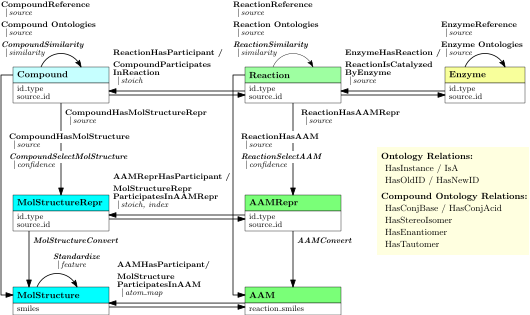
Overview
Entries
Entries in the ChemRecon database represent various types of biochemical objects.
Entries may be source entries. These entries represent those which contain only unmodified information sourced directly from the source databases (See the main page for details).
Each source entry is identified (indexed) by its source_id, the unique identifier, and its id_type, the type
of this identifier.
In addition, each entry has an internal unique identifier, recon_id.
This has no link to the source databases, and it is NOT guaranteed to be stable across ChemRecon versions, so
permanence of this identifer should not be relied upon.
Other entries are structural entries, which are standardized versions of molecular structures and atom-to-atom maps. These are generated by ChemRecon based on the source entries, but are canonicalised and standardised to enable direct comparison.
- class chemrecon.Entry(recon_id: int | None = None)
Bases:
DatabaseObject,ABCGeneric base class for entries.
- get_columns_with_values(include_recon_id=True) dict[Column, Any]
Get the columns of this entry with values.
- get_index_columns_with_values() dict[Column, Any]
Get the index (primary key) columns of this entry with values.
- recon_id: int | None
Internal identifier in the ChemRecon database. Normally, entries have a nonnegative recon_id, unique to the table. A negative recon_id indicates that the object is ‘virtual’, that is, it was created by a procedural relation, and does not exist in the database. A recon_id of None indicates that the entry is not stored in the database.
- Entry types:
Relations
Relations represent various connections between entries.
The source and target entry types define which types of entries the relation refers to. Each relation is identified by its source and target (given by recon_id_1 and recon_id_2), and its attributes, if any.
Symmetric relations are those which have no directonality, and the source/target ordering does not matter. In these cases, the source and target entry types are the same, and the ‘source’ will always be the entry with the lowest recon_id.
Some types of relations come in pairs, of which each is the inverse relation of the other, indicated by a slash (/).
Relation types can be procedural, in which case not all possible relations of this type exists in the database. These relations can be generated on-the-fly when querying relations or when generating entry graphs; this is done automatically and deterministically, so this process is transparent (but may increase runtime). Note that procedural relations cannot be queried or traversed in the backwards direction.
- class chemrecon.Relation(recon_id_1: int | None = None, recon_id_2: int | None = None)
Bases:
DatabaseObject,ABC,GenericGeneric base class for relations between entries.
- get_columns_with_values(include_recon_ids: bool = True) dict[Column, Any]
Get the columns of this entry with values.
- get_index_columns_with_values() dict[Column, Any]
Get the index (primary key) columns of this entry with values. This always includes recon_id_1 and recon_id_2, and may include attribute columns.
- recon_id_1: int | None
Recon ID of source
- recon_id_2: int | None
Recon ID of target
- Relation types:
- Entry graph relation types:
Entries
Source Entries
Compound
- class chemrecon.Compound(source_id: str, id_type: IdTypeCompoundEnum, name: str | None = None, quality: Quality = None, recon_id: int | None = None, properties: list[str] | None = None)
Bases:
SourceEntryRepresents a species entry.
- source_id: str
Identifier of the database entry. (index)
- id_type: IdTypeCompoundEnum
Source of the database entry. (index)
- name: str | None
Name of the database entry. This May be the common name, IUPAC systematic name, or others.
- quality: Quality | None
Indicates the quality of the entry, if this is specified by the source database.
- properties: list[str]
Additional properties
Reaction
- class chemrecon.Reaction(source_id: str, id_type: IdTypeReactionEnum, name: str | None = None, is_transport: bool | None = None, is_reversible: bool | None = None, quality: Quality | None = None, recon_id: int | None = None, properties: list[str] | None = None)
Bases:
SourceEntryRepresents a species entry.
- source_id: str
Identifier of the database entry. (index)
- id_type: IdTypeReactionEnum
Source of the database entry. (index)
- is_transport: bool | None
Whether the reaction is explicitly marked as a transport reaction.
- is_reversible: bool | None
Whether the reaction is explicitly marked as reversible.
- quality: Quality | None
Indicates the quality of the entry, if this is specified by the source database.
- properties: list[str]
Additional properties
Enzyme
- class chemrecon.Enzyme(source_id: str, id_type: IdTypeEnzymeEnum, name: str | None = None, recon_id: int | None = None, quality: Quality | None = None, properties: list[str] | None = None)
Bases:
SourceEntryRepresents an enzyme entry.
- source_id: str
Identifier of the database entry. (index)
- id_type: IdTypeEnzymeEnum
Source of the database entry. Always
ECas of the current version. (index)
- name: str | None
Name of the enzyme.
- quality: Quality | None
Indicates the quality of the entry, if this is specified by the source database.
- properties: list[str]
Additional properties
MolStructureRepr
- class chemrecon.MolStructureRepr(source_id: str, implicit: bool, id_type: IdTypeStructureRepresentationEnum, recon_id: int | None = None)
Bases:
EntryRepresents a representation of a structure, such as an S_SMILES string, S_MOLFILE or similar.
- source_id: str
Identifier string. (index)
- id_type: IdTypeStructureRepresentationEnum
The type of the identifier string (e.g. SMILES, InChI). (index)
- implicit: bool
If marked as implicit, this molecular structure only exists implicitly in an atom-to-atom map, and is not directly referenced by a known species.
AAMRepr
- class chemrecon.AAMRepr(source_id: str, id_type: IdTypeAAMEnum, recon_id: int | None = None)
Bases:
EntryRepresents an enzyme entry.
- source_id: str
Identifier string. (index)
- id_type: IdTypeAAMEnum
The type of the identifier string (e.g. Reaction SMILES). (index)
Structural Entries
MolStructure
- class chemrecon.MolStructure(smiles: str, std_feats: list[FeatureEnum] | None = None, molformula: str | None = None, recon_id: int | None = None)
Bases:
EntryAbstract representation of a structure in SMILES format.
- smiles: str
The canonical SMILES identifier.
- molformula: str | None
The sum formula.
- std_feats: list[FeatureEnum] | None
The features w.r.t which this structure is standardized (see TODO).
AAM
Relations
Compound Relations
CompoundReference
source/target: Compound (symmetric)
CompoundIsA / CompoundHasInstance
source/target: Compound
CompoundHasOldID / CompoundHasNewID
source/target: Compound
- class chemrecon.CompoundHasOldID(src: SourceDatabase, recon_id_1: int | None = None, recon_id_2: int | None = None)
Bases:
InverseRelation[Compound,Compound]Indicates correspondence between identifiers in different database versions. Can be used to resolve deprecated identifiers.
- src: SourceDatabase
The source of the relation
- class chemrecon.CompoundHasNewID(src: SourceDatabase, recon_id_1: int | None = None, recon_id_2: int | None = None)
Bases:
Relation[Compound,Compound]Indicates correspondence between identifiers in different database versions. Can be used to resolve deprecated identifiers.
- src: SourceDatabase
The source of the relation
CompoundHasPart / CompoundIsPartOf
source/target: Compound
CompoundHasConjugateAcid / CompoundHasConjugateBase
source/target: Compound
CompoundHasTautomer
source/target: Compound (symmetric)
CompoundHasStereoIsomer
source/target: Compound (symmetric)
CompoundHasIsotopologue
source/target: Compound (symmetric)
- class chemrecon.CompoundHasIsotopologue(src: SourceDatabase, recon_id_1: int | None = None, recon_id_2: int | None = None)
Bases:
Relation[Compound,Compound]Represents that two species are considered isotopologues of each other. (identical in elements, but different isotopic composition).
- src: SourceDatabase
The source of the relation
Reaction Relations
ReactionInvolvesCompound / CompoundParticipatesInReaction
source: Reaction, target: Compound
- class chemrecon.ReactionInvolvesCompound(n: int, recon_id_1: int | None = None, recon_id_2: int | None = None)
Bases:
Relation[Reaction,Compound]Each reaction is connected by this relation to the species which take part in the reaction, annotated with the stoichiometric coefficient.
- n: int
The stoichiometric coefficient of the species in the reaction
- class chemrecon.CompoundParticipatesInReaction(n: int, recon_id_1: int | None = None, recon_id_2: int | None = None)
Bases:
InverseRelation[Compound,Reaction]Each reaction is connected by this relation to the species which take part in the reaction, annotated with the stoichiometric coefficient.
- n: int
The stoichiometric coefficient of the species in the reaction
ReactionReference
source/target: Reaction (symmetric)
ReactionIsA / ReactionHasInstance
source/target: Reaction
- class chemrecon.ReactionIsA(src: SourceDatabase, recon_id_1: int | None = None, recon_id_2: int | None = None)
Bases:
Relation[Reaction,Reaction]Hierarchical relation which indicates that a reaction is a member of a class of reactions.
- src: SourceDatabase
The source of the relation
- class chemrecon.ReactionHasInstance(src: SourceDatabase, recon_id_1: int | None = None, recon_id_2: int | None = None)
Bases:
InverseRelation[Reaction,Reaction]Hierarchical relation which indicates that a reaction is a member of a class of reactions.
- src: SourceDatabase
The source of the relation
ReactionHasNewID / ReactionHasOldID
source/target: Reaction
- class chemrecon.ReactionHasNewID(src: SourceDatabase, recon_id_1: int | None = None, recon_id_2: int | None = None)
Bases:
Relation[Reaction,Reaction]Indicates correspondence between identifiers in different database versions. Can be used to resolve deprecated identifiers.
- src: SourceDatabase
The source of the relation
- class chemrecon.ReactionHasOldID(src: SourceDatabase, recon_id_1: int | None = None, recon_id_2: int | None = None)
Bases:
InverseRelation[Reaction,Reaction]Indicates correspondence between identifiers in different database versions. Can be used to resolve deprecated identifiers.
- src: SourceDatabase
The source of the relation
Enzyme Relations
EnzymeCatalyzesReaction / ReactionHasEnzyme
EnzymeIsA / EnzymeHasInstance
source/target: Enzyme
- class chemrecon.EnzymeIsA(src: SourceDatabase, recon_id_1: int | None = None, recon_id_2: int | None = None)
Bases:
Relation[Enzyme,Enzyme]Hierarchical relation which indicates that an enzyme is a member of a class of enzymes. The EC number means that this can be automatically resolved, e.g. 1.2.3.4 is_a 1.2.3
- src: SourceDatabase
The source of the relation
- class chemrecon.EnzymeHasInstance(src: SourceDatabase, recon_id_1: int | None = None, recon_id_2: int | None = None)
Bases:
InverseRelation[Enzyme,Enzyme]Hierarchical relation which indicates that an enzyme is a member of a class of enzymes. The EC number means that this can be automatically resolved, e.g. 1.2.3.4 is_a 1.2.3
- src: SourceDatabase
The source of the relation
Molecular Structure Representation Relations
CompoundHasStructureRepresentation
- class chemrecon.CompoundHasStructureRepresentation(src: SourceDatabase = unknown, recon_id_1: int | None = None, recon_id_2: int | None = None)
Bases:
Relation[Compound,MolStructureRepr]Relates a species entry to the structure representation (e.g. SMILES, InChI) given by that database.
- src: SourceDatabase
The source database containing this representation.
Atom-to-Atom Map Representation Relations
ReactionHasAAMRepr
AAMReprInvolvesMolStructureRepr / MolStructureReprParticipatesInAAMRepr
- class chemrecon.AAMReprInvolvesMolStructureRepr(index: int, stoich: int, recon_id_1: int | None = None, recon_id_2: int | None = None)
Bases:
Relation[AAMRepr,MolStructureRepr]Relates the molecular structure representation involved in an atom-to-atom-mapped reaction. These molecular structures are implicitly a part of the AAM structure.
- index: int
Index in the mapping string
- stoich: int
The stoichiometric coefficient of the MolStructureRepr
- class chemrecon.MolStructureReprParticipatesInAAMRepr(index: int, stoich: int, recon_id_1: int | None = None, recon_id_2: int | None = None)
Bases:
InverseRelation[MolStructureRepr,AAMRepr]Relates the molecular structure representation involved in an atom-to-atom-mapped reaction. These molecular structures are implicitly a part of the AAM structure.
- index: int
Index in the mapping string
- stoich: int
The stoichiometric coefficient of the MolStructureRepr
Molecular Structure Relations
CompoundHasMolStructure
- class chemrecon.CompoundHasMolStructure(rel_1: CompoundHasStructureRepresentation, rel_2: MolStructureConvert, intermediate: MolStructureRepr = None, recon_id_1: int | None = None, recon_id_2: int | None = None)
Bases:
ComposedRelation[Compound,MolStructure,MolStructureRepr]This relation gives the associated molecular structures of a species in a standardized format. This relation is composed of the CompoundHasMolStructureRepr relation and the MolStructureConvert relations. So if a species entry includes an InChI, Molfile representation of a structure, this relation gives the same structure in the standardized, SMILES-based format.
- src: SourceDatabase
The source database containing this structure.
- classmethod new_from_table(recon_id_1: int | None, recon_id_2: int | None, src: SourceDatabase = None) Self
Given values from a view, create a new instance
MolStructureStandardization
- class chemrecon.MolStructureStandardization(feat: FeatureEnum, recon_id_1: int | None = None, recon_id_2: int | None = None)
Bases:
ProceduralRelation[MolStructure,MolStructure]Standardization of molecular structures according to a particular ‘feature’ (Fragment, Isotope, Charge, Tautomerism, Stereochemical).
- feat: FeatureEnum
The feature w.r.t. which the structure is standardized.
- classmethod generate(take_entry: MolStructure) list[tuple[ProceduralRelation[MolStructure, MolStructure], MolStructure]]
Given a T1, generate relations from that.
MolStructureConvert
- class chemrecon.MolStructureConvert(recon_id_1: int | None = None, recon_id_2: int | None = None)
Bases:
ProceduralRelation[MolStructureRepr,MolStructure]Standardized and canonical conversion of molecular structure representations (e.g. SMILES, InChI, …) into a consistent format, stored as a canonical SMILES string.
- classmethod generate(take_entry: MolStructureRepr) list[tuple[ProceduralRelation[MolStructureRepr, MolStructure], MolStructure]]
Given a T1, generate relations from that.
Atom-to-Atom Map Relations
ReactionHasAAM
- class chemrecon.ReactionHasAAM(rel_1: ReactionHasAAMRepr, rel_2: AAMConvert, intermediate: AAMRepr, recon_id_1: int | None = None, recon_id_2: int | None = None)
Bases:
ComposedRelation[Reaction,AAM,AAMRepr]This relation gives the associated AAM of a reaction in a standardized format. This relation is composed of the ReactionHasAAMRepr relation and the AAMConvert relations. So if a reaction entry includes an RXN or GML representation of a map, this relation gives the same map in the standardized, ReactionSMILES-based format.
- src: SourceDatabase
The source database specifying this AAM.
- classmethod new_from_table(recon_id_1: int | None, recon_id_2: int | None, src: SourceDatabase = None) Self
Given values from a view, create a new instance
AAMConvert
AAMInvolvesMolStructure / MolStructureParticipatesInAAM
- class chemrecon.AAMInvolvesMolStructure(side: int, structure_atom_index_in_aam: list[int], recon_id_1: int | None = None, recon_id_2: int | None = None)
Bases:
Relation[AAM,MolStructure]Relates the molecular structures involved in an atom-to-atom-mapped reaction. These molecular structures are implicitly a part of the AAM structure.
- side: int
The side of the reaction which contains this structure (-1 or 1)
- structure_atom_index_in_aam: list[int]
Atom mapping numbers of the atoms in the structure w.r.t. the AAM.
- class chemrecon.MolStructureParticipatesInAAM(side: int, structure_atom_index_in_aam: list[int], recon_id_1: int | None = None, recon_id_2: int | None = None)
Bases:
InverseRelation[MolStructure,AAM]Relates the molecular structures involved in an atom-to-atom-mapped reaction. These molecular structures are implicitly a part of the AAM structure.
- side: int
The side of the reaction which contains this structure (-1 or 1)
- structure_atom_index_in_aam: list[int]
Atom mapping numbers of the atoms in the structure w.r.t. the AAM.
Entry Graph Relations
These relations are based on the results of the entry graph scoring algorithm.
CompoundSelectStructure
- class chemrecon.CompoundSelectStructure(recon_id_1: int | None = None, recon_id_2: int | None = None, score: float = 0.0)
Bases:
ProceduralRelationEG[Compound,MolStructure]Procedural relation which computes the most related molecular structures for a given species using entry graph scoring.
- score: float
The score of the target entry in the entry graph.
- recon_id_1: int | None
Recon ID of source
- recon_id_2: int | None
Recon ID of target
ReactionSelectAAM
- class chemrecon.ReactionSelectAAM(recon_id_1: int | None = None, recon_id_2: int | None = None, score: float = 0.0)
Bases:
ProceduralRelationEG[Reaction,AAM]Procedural relation which computes the most related AAMs for a given reaction using entry graph scoring.
- score: float
The score of the target entry in the entry graph.
- recon_id_1: int | None
Recon ID of source
- recon_id_2: int | None
Recon ID of target